

Why do 80% of all AI projects fail? Fear of AI costs companies billions. Download the free mentalport Research Report 2026 now.

Companies are investing more in artificial intelligence today than ever before. According to BCG, global AI spending exceeded 252 billion US dollars in 2024. But three out of four companies did not generate any tangible economic value from this. It's not a technology issue. It is a human issue.
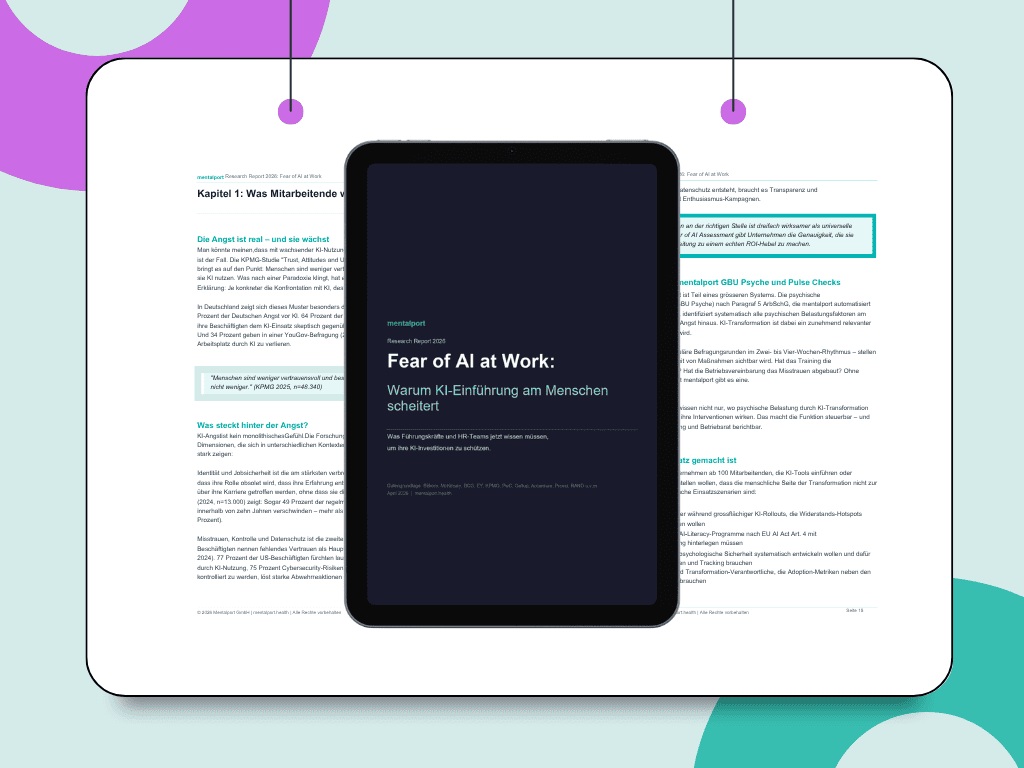
The mentalport Research Report 2026 “Fear of AI at Work” summarizes the current state of global research on a topic that simply does not appear in most AI roadmaps: What happens in people's minds when AI moves into their working world? Which psychological mechanisms determine whether an AI initiative brings returns or ends up in a drawer? And what exactly can management teams and HR managers do about it today?
The answers are uncomfortable — but measurable. And that's exactly why it's important.
The report is divided into six chapters and builds on each other: from psychological diagnosis and economic classification to specific fields of action and the instrument that makes the invisible visible.
Chapter 1 — What employees really think about AIThe research is clear: fear of AI grows with use, not in spite of it. This chapter introduces the four core psychological dimensions of Fear of AI — from loss of identity to data mistrust to silent denial — and shows which groups are most affected. The power user paradox, which Upwork (2025, n=2,500) documents, is one of the most surprising and significant findings: Whoever uses AI the most intensively is the most productive — and at the same time the most frequently at risk of burnout and ready to quit.
Chapter 2 — Why AI projects really fail63 percent of all implementation challenges are human factors — not technical ones (Prosci 2024, n=1,107). This chapter quantifies what this means in real budgets: Without an adoption strategy, a company conservatively burns 70—80 percent of its AI investment. The figures from the RAND analysis, McKinsey and EY show that this is not a marginal phenomenon.
Chapter 3 — Psychological safety as a key variableReich et al. (arXiv 2026, n=2,257) prove empirically: Psychological safety is a reliable predictor of whether employees adopt AI tools. 83 percent of the managers surveyed see them as a measurable success factor (MIT Technology Review 2025). The chapter explains the mechanism and shows what high-performer organizations do structurally differently.
Chapter 4 — The legal frameworkFrom August 2026, AI literacy is mandatory (EU AI Act, Article 4). This chapter explains what this means in practice, what sanctions are imminent and why the works council must be an early stakeholder in the AI context — and not a downstream approval problem.
Chapter 5 — Ten areas of action for HR decision makersNot an abstract conclusion, but ten empirically based fields of action that can be implemented immediately: from the budget rule for change management to the governance recommendation for Shadow AI to the question of how to systematically identify burnout risks among AI champions before they go.
Chapter 6 — How mentalport starts hereThe report concludes with a specific classification: How the Fear of AI Assessment based on the scientifically validated FAIW-10 instrument (Giermindl et al. 2024, Journal of Business Research) makes the four dimensions measurable in less than ten minutes per person — anonymously, with immediate heat map evaluation at department and management level and automatically derived measures.
You'll find the report useful if you're in one of the following situations:
You are responsible for HR, People & Culture or Organizational Development and want to understand why your AI initiative is producing more resistance than expected — and what you can do about it without relying on gut feeling.
You are in a management position and want to back up the decision for or against an accompanying adoption strategy during an AI introduction with data — vis-à-vis management, works council or budget managers.
You are planning or managing an AI transformation and want to know what psychological risks you need to price in order not to end up in the 74 percent majority, which does not achieve any measurable value.
You are responsible for compliance or occupational safety and want to understand what the EU AI Act specifically requires of your organization from August 2026.
You download the report and receive it immediately as a PDF. No waiting, no manual confirmation.
If you want, you can start the free Fear of AI Assessment immediately afterwards — anonymously, in under ten minutes per person, with immediate impact assessment at individual and organizational level. In this way, the report is not a readable copy for the drawer, but the first step towards real data about the state of your workforce.
The report is based on more than 20 global primary studies with a total of several hundred thousand respondents, including BCG (2024/2025), KPMG/University of Melbourne (2025, n=48,340), Prosci AI Adoption Research (2024, n=1,107), RAND Corporation (2024), Upwork Research Institute (2024/2025, n=2,500), Microsoft/LinkedIn Work Trend Index (2024, n=2,500) 31,000), MIT Technology Review (2025), Reich et al. arXiv (2026, n=2,257) as well as Bitkom, EY, Accenture, Gallup, PwC, Slack, S&P Global and more.
The full list of sources is included in the report.




_11zon.jpg)


